Gun3P tutorial: sheet beam klystron gun
Example directory: examples/gun3p/LSBK
A DC gun for a sheet beam klystron: a wide, flat cathode at ground, a focus electrode at −500 V, and an anode at 115 kV. The beam exits through the anode aperture toward a screen 16 cm downstream. Gun3P finds the self-consistent emitted current and the beam shape at the screen.
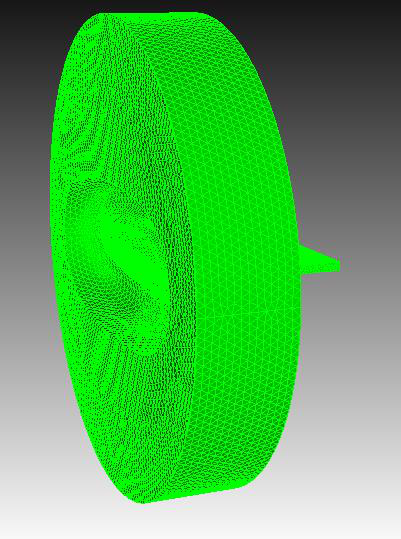
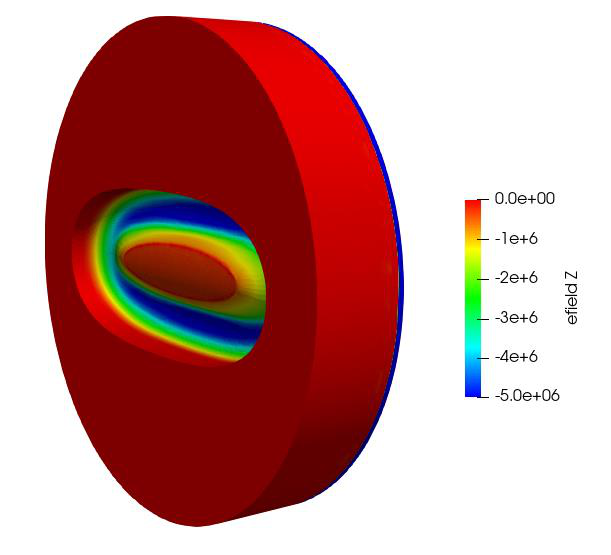
The full-model mesh, and the electrostatic potential: anode (red, 115 kV), cathode and focus electrode (blue, near 0 V).
Mesh from a STEP file
Unlike the other tutorials, this geometry arrives as a CAD STEP file rather than a Cubit journal. The journal imports and heals it, refines the cathode surfaces, meshes, and assigns sidesets by explicit surface lists.
reset
import step "SBK_3D.step" heal

surface 1 size 3                           # cathode
surface 47 size 3
volume all scheme tetmesh
vol 1 sizing function skeleton scale 3 min_size 0.1 max_size 7 max_gradient 1.3
mesh volume all

sideset 1 surface 1 47                     # cathode
sideset 2 surface 33 12 3 23 32 31 48 49 22 21 10 11   # focus electrode
sideset 3 surface 34                       # open boundary
sideset 4 surface 2 36
sideset 12 surface 4 5 6 7 8 9 13 14 15 16 17 18 19 20 24 25 26 27 28 29 30 35 37 38 40 41 42 43 44 45 46   # anode
sideset 10 surface 39                      # open boundary

block 1 volume 1
block all element type tetra10
volume all scale 0.001
export genesis "dcgun.gen" overwrite
import step ... heal repairs small CAD defects on import. The result is 459,206 elements with boundary IDs 1, 2, 3, 4, 10, 12. Long explicit surface lists like the anode's are fragile; for your own models prefer Cubit groups selected by coordinate or by name, as the Cubit page describes.
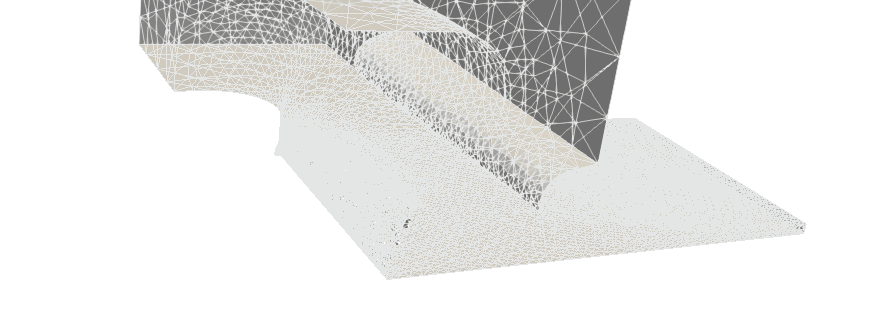
The cathode, focus electrode, and anode nose. The mesh is refined at the cathode where emission is computed.
Input
The full file is shown on the module page. The decisions it encodes:
- Full model,
SymmetryFactor: 1. The gun is not symmetric enough in its CAD representation to cut. - Voltages. Cathode 0 V, focus electrode −500 V, anode 115 kV. The small negative bias on the focus electrode shapes the beam edge.
- Both field solvers.
MagnetostaticProblemis present, so the beam's self-magnetic field is included onceFirstIterationForMagnetostaticProblemis reached. In the shipped file that key is commented out, so the magnetostatic solve is set up but never activated; the run is electrostatic only. - 32 iterations, with the fields and particles of each saved.
- Screen at z = 0.15999 m, just before the exit boundary at 0.16, collecting emittances and current density on an 11 by 80 grid.
- Child-Langmuir emission from the whole cathode, five macroparticles per face, each representing one electron, with a 0.1 mm space-charge radius.
Run
The run completed in 232 s on 256 ranks. Standard output carries the iteration history; gun3p_results/gun3p.log has only the timing summary.
Convergence
The emitted current and micro-perveance from the Child-Langmuir model, per iteration:
| Iteration | Emitted current (A) | Micro-perveance (μA/V3/2) |
|---|---|---|
| 0 | 562.6 | 7.21 |
| 1 | 475.1 | 7.21 |
| 2 | 370.1 | 9.70 |
| 8 | 124.1 | 8.39 |
| 16 | 127.5 | 4.04 |
| 24 | 128.4 | 3.18 |
| 31 | 128.4 | 3.29 |
The first guess, with no space charge in the field, over-emits by a factor of four. Space charge builds up over the first ten iterations and suppresses the emission to its self-consistent value of 128.4 A, after which the current is steady and only the field keeps refining. The relative change in the electric field falls from 2.4×10⁻³ at iteration 1 to 1.6×10⁻⁵ at iteration 31, far from the 10⁻¹² tolerance in the input, so the run ended on MaxIterations. That is normal: the tolerance in the shipped file is unreachable in double precision, and 10⁻⁵ is well converged for engineering purposes.
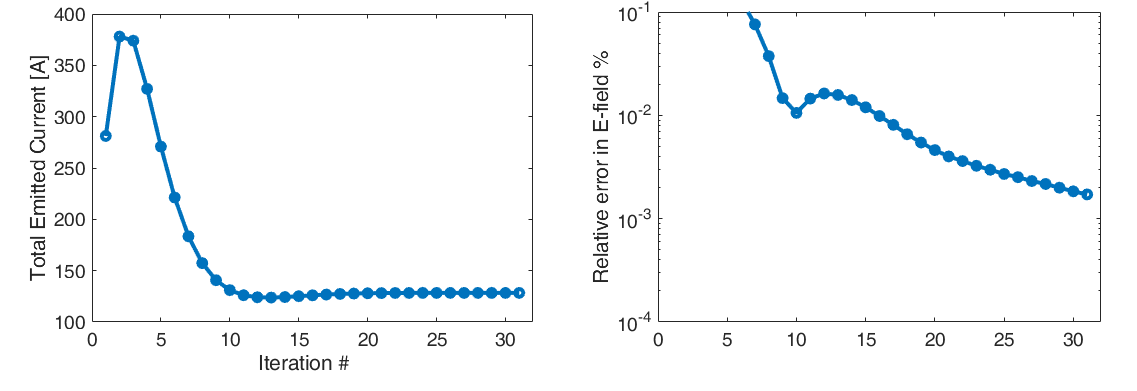
Total emitted current and relative field error against iteration, from the workshop slides. The current settles by iteration 12; the field continues to converge geometrically.
Comparison with MICHELLE
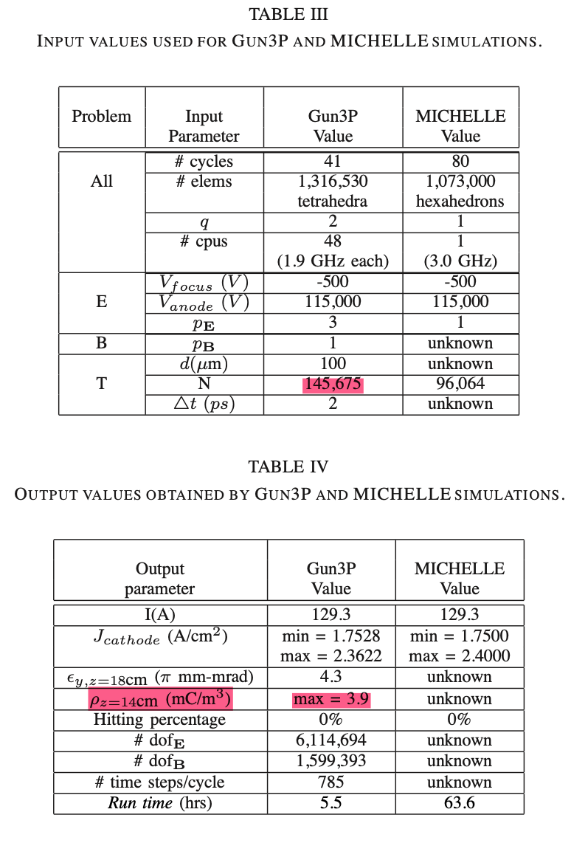
The same gun was simulated with MICHELLE, a commercial finite-element gun code. From the published comparison:
| Quantity | Gun3P | MICHELLE |
|---|---|---|
| Elements | 1,316,530 tetrahedra | 1,073,000 hexahedra |
| Basis order | 2 | 1 |
| Emitted current | 129.3 A | 129.3 A |
| Cathode current density | 1.75 to 2.36 A/cm² | 1.75 to 2.40 A/cm² |
| Beam hitting electrodes | 0 % | 0 % |
| Run time | 5.5 h on 48 cores | 63.6 h on 1 core |
The tutorial's coarser 459,000-element mesh gives 128.4 A, within 0.7 percent of the fine-mesh value.
Post-process
writes OUTPUT/E/staticDofs.ncdf.mod and the magnetic equivalent. In ParaView, load dcgun.ncdf with that .mod file for the potential and field, and add the OUTPUT/PARTICLES/partpath_ts*.ncdf series to animate the beam from cathode to screen. The screen monitor's emittances are in the standard output, labelled plane monitor 'screen', in π mm·mrad.
Variations
- Turn on the self-magnetic field. Uncomment
FirstIterationForMagnetostaticProblem: 1or set it to an iteration after the current has settled. For a 129 A beam the magnetic self-pinch is not negligible. - Trim the iterations. The current is converged by iteration 12. Set
MaxIterationsaccordingly and halve the run time, or raiseCharge averaging factorcautiously to converge in fewer. - Export the field for Track3P. Add
ElectrostaticFieldToken: Onwith aFileNameandNx,Ny,NztoOutputs, rerun the converter, and the Cartesian field file can be loaded in Track3P as a static field alongside an RF field. TheCoax-StaticFieldexample underexamples/track3pdoes exactly this. - Electrostatic only. Remove the
Trackerblock and setMaxIterations: 0to use Gun3P as a plain electrostatic solver for electrode design.