Memory interface Hub device. More...
#include <Hub.h>
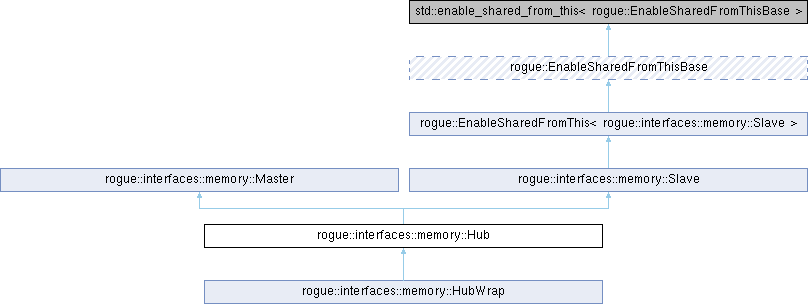
Public Member Functions | |
| Hub (uint64_t offset, uint32_t min, uint32_t max) | |
| Constructs a Hub with optional virtual-root access constraints. | |
| ~Hub () | |
| Destroy a block. | |
| uint64_t | getOffset () |
| Returns the local offset of this hub. | |
| uint64_t | getAddress () |
| Returns the full address of this hub, including local offset. | |
| uint32_t | doSlaveId () |
Services getSlaveId request from an attached master. | |
| std::string | doSlaveName () |
Services getSlaveName request from an attached master. | |
| uint32_t | doMinAccess () |
Services getMinAccess request from an attached master. | |
| uint32_t | doMaxAccess () |
Services getMaxAccess request from an attached master. | |
| uint64_t | doAddress () |
Services getAddress request from an attached master. | |
| virtual void | doTransaction (std::shared_ptr< rogue::interfaces::memory::Transaction > transaction) |
| Services a transaction request from an attached master. | |
 Public Member Functions inherited from rogue::interfaces::memory::Master Public Member Functions inherited from rogue::interfaces::memory::Master | |
| Master () | |
| Constructs a memory master instance. | |
| virtual | ~Master () |
| Destroys the memory master instance. | |
| virtual void | stop () |
| Stops the interface and releases runtime resources. | |
| void | setSlave (std::shared_ptr< rogue::interfaces::memory::Slave > slave) |
| Sets the downstream slave or hub. | |
| std::shared_ptr< rogue::interfaces::memory::Slave > | getSlave () |
| Returns the configured downstream slave or hub. | |
| uint32_t | reqSlaveId () |
| Queries the downstream slave ID. | |
| std::string | reqSlaveName () |
| Queries the downstream slave name. | |
| uint32_t | reqMinAccess () |
| Queries minimum access size in bytes for this interface path. | |
| uint32_t | reqMaxAccess () |
| Queries maximum access size in bytes for this interface path. | |
| uint64_t | reqAddress () |
| Queries the address offset of the next downstream layer. | |
| std::string | getError () |
| Returns the last transaction error string. | |
| void | clearError () |
| Clears the stored transaction error string. | |
| void | setTimeout (uint64_t timeout) |
| Sets the timeout value for future transactions. | |
| uint32_t | reqTransaction (uint64_t address, uint32_t size, void *data, uint32_t type) |
| Starts a new transaction. | |
| uint32_t | reqTransactionPy (uint64_t address, boost::python::object p, uint32_t size, uint32_t offset, uint32_t type) |
Python variant of reqTransaction. | |
| void | rshiftPy (boost::python::object p) |
Supports >> operator usage from Python. | |
| std::shared_ptr< rogue::interfaces::memory::Slave > & | operator>> (std::shared_ptr< rogue::interfaces::memory::Slave > &other) |
| Connects this master to a slave via stream chaining operator. | |
| void | waitTransaction (uint32_t id) |
| Waits for transaction completion or timeout. | |
| Public Member Functions inherited from rogue::interfaces::memory::Slave | |
| Slave (uint32_t min, uint32_t max) | |
| Constructs a memory slave. | |
| virtual | ~Slave () |
| Destroys the memory slave instance. | |
| virtual void | stop () |
| Stops the memory slave interface. | |
| void | addTransaction (std::shared_ptr< rogue::interfaces::memory::Transaction > transaction) |
| Adds a transaction to the internal tracking map. | |
| std::shared_ptr< rogue::interfaces::memory::Transaction > | getTransaction (uint32_t index) |
| Gets a transaction from the internal tracking map. | |
| uint32_t | min () |
| Returns configured minimum transaction size. | |
| uint32_t | max () |
| Returns configured maximum transaction size. | |
| uint32_t | id () |
| Returns unique slave ID. | |
| void | setName (std::string name) |
| Sets slave name. | |
| std::string | name () |
| Returns slave name. | |
| void | lshiftPy (boost::python::object p) |
Supports << operator usage from Python. | |
| std::shared_ptr< rogue::interfaces::memory::Master > & | operator<< (std::shared_ptr< rogue::interfaces::memory::Master > &other) |
| Connects this slave to a master via chaining operator. | |
| Public Member Functions inherited from rogue::EnableSharedFromThis< rogue::interfaces::memory::Slave > | |
| std::shared_ptr< rogue::interfaces::memory::Slave > | shared_from_this () |
Returns a shared_ptr<T> for this instance. | |
| Public Member Functions inherited from rogue::EnableSharedFromThisBase | |
| virtual | ~EnableSharedFromThisBase () |
| Virtual destructor for polymorphic base usage. | |
Static Public Member Functions | |
| static std::shared_ptr< rogue::interfaces::memory::Hub > | create (uint64_t offset, uint32_t min, uint32_t max) |
| Creates a memory Hub. | |
| static void | setup_python () |
| Static Public Member Functions inherited from rogue::interfaces::memory::Master | |
| static std::shared_ptr< rogue::interfaces::memory::Master > | create () |
| Creates a memory master instance. | |
| static void | setup_python () |
| Registers this type with Python bindings. | |
| static void | copyBits (uint8_t *dstData, uint32_t dstLsb, uint8_t *srcData, uint32_t srcLsb, uint32_t size) |
| Copies bits between two byte arrays. | |
| static void | copyBitsPy (boost::python::object dst, uint32_t dstLsb, boost::python::object src, uint32_t srcLsb, uint32_t size) |
Python wrapper for copyBits. | |
| static void | setBits (uint8_t *dstData, uint32_t lsb, uint32_t size) |
| Sets a contiguous bit range in a byte array. | |
| static void | setBitsPy (boost::python::object dst, uint32_t lsb, uint32_t size) |
Python wrapper for setBits. | |
| static bool | anyBits (uint8_t *srcData, uint32_t lsb, uint32_t size) |
| Tests whether any bit in a range is set. | |
| static bool | anyBitsPy (boost::python::object src, uint32_t lsb, uint32_t size) |
Python wrapper for anyBits. | |
| Static Public Member Functions inherited from rogue::interfaces::memory::Slave | |
| static std::shared_ptr< rogue::interfaces::memory::Slave > | create (uint32_t min, uint32_t max) |
| Creates a memory slave. | |
| static void | setup_python () |
| Registers this type with Python bindings. | |
Additional Inherited Members | |
| Protected Member Functions inherited from rogue::interfaces::memory::Master | |
| uint32_t | intTransaction (std::shared_ptr< rogue::interfaces::memory::Transaction > tran) |
| Starts an internal transaction from an existing transaction object. | |
Detailed Description
Memory interface Hub device.
The memory bus Hub serves as both a Slave and a Master for memory transactions. It will accept a Transaction from an attached Master and pass it down to the next level Slave or Hub device. It will apply its local offset address to the transaction as it is passed down to the next level.
A Hub can be sub-classed in either Python or C++ is order to further manipulate the transaction data on the way down or convert the initial Transaction into multiple transactions to the next level. This can be useful to hide complex windows memory spaces or transactions that require multiplied steps be performed in hardware.
If a non zero min and max transaction size are passed at creation this Hub will behave as if it is a new root Slave memory device in the tree. This is useful in cases where this Hub will master a paged address or other virtual address space.
Access-size behavior is selected by the min/max constructor parameters:
min == 0andmax == 0: pass-through mode. Access-size identity/name queries are forwarded to the downstream interface.min != 0andmax != 0: virtual-root mode. This hub advertises its own Slave-like identity and access limits (min/max) to upstream masters.- Mixed values (
min == 0, max != 0ormin != 0, max == 0): also pass-through mode (virtual-root mode is not enabled).
In other words, this hub behaves as a virtual root only when both min and max are non-zero.
A pyrogue.Device instance is the most typical Hub used in Rogue.
Constructor & Destructor Documentation
◆ Hub()
| rogue::interfaces::memory::Hub::Hub | ( | uint64_t | offset, |
| uint32_t | min, | ||
| uint32_t | max | ||
| ) |
Constructs a Hub with optional virtual-root access constraints.
Create an block.
This constructor is a low-level C++ allocation path. Prefer create() when shared ownership or Python exposure is required.
Virtual-root mode is enabled only when both min and max are non-zero. When both are zero, the hub behaves as a pass-through for access-limit queries. Mixed values (only one non-zero) also behave as pass-through.
- Parameters
-
offset The offset of this Hub device. min Minimum transaction size in virtual-root mode. Use 0withmax=0to disable virtual-root mode.max Maximum transaction size in virtual-root mode. Use 0withmin=0to disable virtual-root mode.
◆ ~Hub()
Member Function Documentation
◆ create()
|
static |
Creates a memory Hub.
Create a block, class creator.
Exposed to Python as rogue.interfaces.memory.Hub(). This static factory is the preferred construction path when the object is shared across Rogue graph connections or exposed to Python. It returns std::shared_ptr ownership compatible with Rogue pointer typedefs. Parameter semantics are identical to the constructor; see Hub() for virtual-root behavior details.
- Parameters
-
offset The offset of this Hub device. min Minimum transaction size in virtual-root mode. Use 0withmax=0to disable virtual-root mode.max Maximum transaction size in virtual-root mode. Use 0withmin=0to disable virtual-root mode.
- Returns
- Shared pointer to the created hub.
Company : SLAC National Accelerator Laboratory
Description: A memory interface hub. Accepts requests from multiple masters and forwards them to a downstream slave. Address is updated along the way. Includes support
for modification callbacks.
This file is part of the rogue software platform. It is subject to the license terms in the LICENSE.txt file found in the top-level directory of this distribution and at: https://confluence.slac.stanford.edu/display/ppareg/LICENSE.html. No part of the rogue software platform, including this file, may be copied, modified, propagated, or distributed except according to the terms
contained in the LICENSE.txt file.
◆ doAddress()
|
virtual |
Services getAddress request from an attached master.
Return address.
This hub forwards the request to the next-level device and applies the local address offset. A Hub sub-class is allowed to override this method.
Not exposed to Python
- Returns
- 64-bit address including this hub offset
Reimplemented from rogue::interfaces::memory::Slave.
◆ doMaxAccess()
|
virtual |
Services getMaxAccess request from an attached master.
Return max access size to requesting master.
This hub forwards the request to the next-level device. A hub sub-class is allowed to override this method.
Not exposed to Python
- Returns
- Max transaction access size
Reimplemented from rogue::interfaces::memory::Slave.
◆ doMinAccess()
|
virtual |
Services getMinAccess request from an attached master.
Return min access size to requesting master.
This hub forwards the request to the next-level device.
Not exposed to Python
- Returns
- Min transaction access size
Reimplemented from rogue::interfaces::memory::Slave.
◆ doSlaveId()
|
virtual |
Services getSlaveId request from an attached master.
Return id to requesting master.
By default the Hub forwards this request to the next level. A hub may want to override this when mastering a virtual address space such as a paged address map. Otherwise incorrect overlap errors may be generated by the PyRogue Root.
Not exposed to Python
- Returns
- 32-bit slave ID
Reimplemented from rogue::interfaces::memory::Slave.
◆ doSlaveName()
|
virtual |
Services getSlaveName request from an attached master.
Return name to requesting master.
By default the Hub forwards this request to the next level. A hub may want to override this when mastering a virtual address space such as a paged address map. Otherwise incorrect overlap errors may be generated by the PyRogue Root.
Not exposed to Python
- Returns
- slave name
Reimplemented from rogue::interfaces::memory::Slave.
◆ doTransaction()
|
virtual |
Services a transaction request from an attached master.
Post a transaction. Master will call this method with the access attributes.
This hub forwards the request to the next-level device and applies the local address offset.
It is possible for this method to be overridden in either a Python or C++ subclass. Examples of sub-classing a Hub are included elsewhere in this document.
Exposed to Python as _doTransaction().
- Parameters
-
transaction Transaction pointer as TransactionPtr.
Reimplemented from rogue::interfaces::memory::Slave.
Reimplemented in rogue::interfaces::memory::HubWrap.
◆ getAddress()
| uint64_t rogue::interfaces::memory::Hub::getAddress | ( | ) |
◆ getOffset()
| uint64_t rogue::interfaces::memory::Hub::getOffset | ( | ) |
◆ setup_python()
|
static |
The documentation for this class was generated from the following files: