Distributed System
Squirrel Backend uses a distributed architecture with separate processes for different concerns, enabling horizontal scaling and fault isolation.
Core Components
1. API Server (app/main.py)
FastAPI application serving REST and WebSocket endpoints. Decoupled from PV monitoring for fast startup and fault isolation.
Startup Sequence:
- Initialize EPICS service (for direct reads during snapshot restore)
- Connect to Redis (used for reading cached values)
- Start WebSocket DiffManager (subscribes to Redis pub/sub)
Key Features:
- Sub-second startup time (no PV subscription blocking)
- Horizontally scalable behind load balancer
- Crash-isolated from EPICS/aioca issues
2. PV Monitor (app/monitor_main.py)
Dedicated process for EPICS PV monitoring. Runs as a single instance with leader election.
Responsibilities:
- Subscribe to all PVs via aioca monitors
- Update Redis cache with PV values
- Publish updates to Redis pub/sub
- Run Watchdog for health checks
Leader Election:
- Uses Redis lock (
squirrel:monitor:lock) with TTL - Prevents duplicate monitoring in multi-instance deployments
- Auto-recovers if leader dies
3. Arq Worker (app/worker.py)
Background task processor using Redis-backed Arq queue.
Features:
- Job persistence across restarts
- Automatic retries with exponential backoff
- Scalable (can run multiple workers)
- 10-minute job timeout
Tasks:
create_snapshot_task- Create snapshots from cache or EPICSrestore_snapshot_task- Restore snapshot values to EPICS
4. Configuration (app/config.py)
Pydantic-Settings with environment variable support (prefix: SQUIRREL_):
| Category | Key Settings |
|---|---|
| Database | database_url, database_pool_size (30), database_max_overflow (20) |
| EPICS | epics_ca_timeout (10s), epics_ca_conn_timeout (5s), epics_chunk_size (1000) |
| Redis | redis_url, redis_pv_cache_ttl (60s) |
| PV Monitor | pv_monitor_batch_size (500), pv_monitor_batch_delay_ms (100) |
| Watchdog | watchdog_check_interval (60s), watchdog_stale_threshold (300s) |
| WebSocket | websocket_batch_interval_ms (100) |
EPICS network discovery (EPICS_CA_ADDR_LIST, EPICS_PVA_ADDR_LIST, etc.) is configured via the standard EPICS library env vars — not through Pydantic settings.
Performance Optimizations
1. Process Isolation
- API starts in <1s (no PV subscription blocking)
- Monitor crash doesn't affect API
- Workers can scale independently
2. Database
- Connection pooling (30 + 20 overflow)
- PostgreSQL COPY for bulk inserts (10x faster)
- ID-based pagination (no OFFSET)
- Indexes on search fields
3. EPICS
- Batched PV startup (500/batch, 100ms delay) prevents UDP flood
- Async operations via aioca (no blocking)
- Circuit breaker prevents cascading timeouts
- Connection pre-caching
4. Redis Caching
- Instant snapshot reads (<5s for 40K PVs)
- PV Monitor maintains fresh cache
- Pub/Sub for efficient broadcasts
5. WebSocket
- Diff-based streaming (only deltas)
- 100ms batching window
- Redis-based subscription registry for multi-instance
- Reduces bandwidth 10-100x
6. Task Queue
- Jobs persist across restarts
- Automatic retries for transient failures
- Progress tracking in database
Circuit Breaker Pattern
The circuit breaker prevents cascading failures when EPICS IOCs become unresponsive.
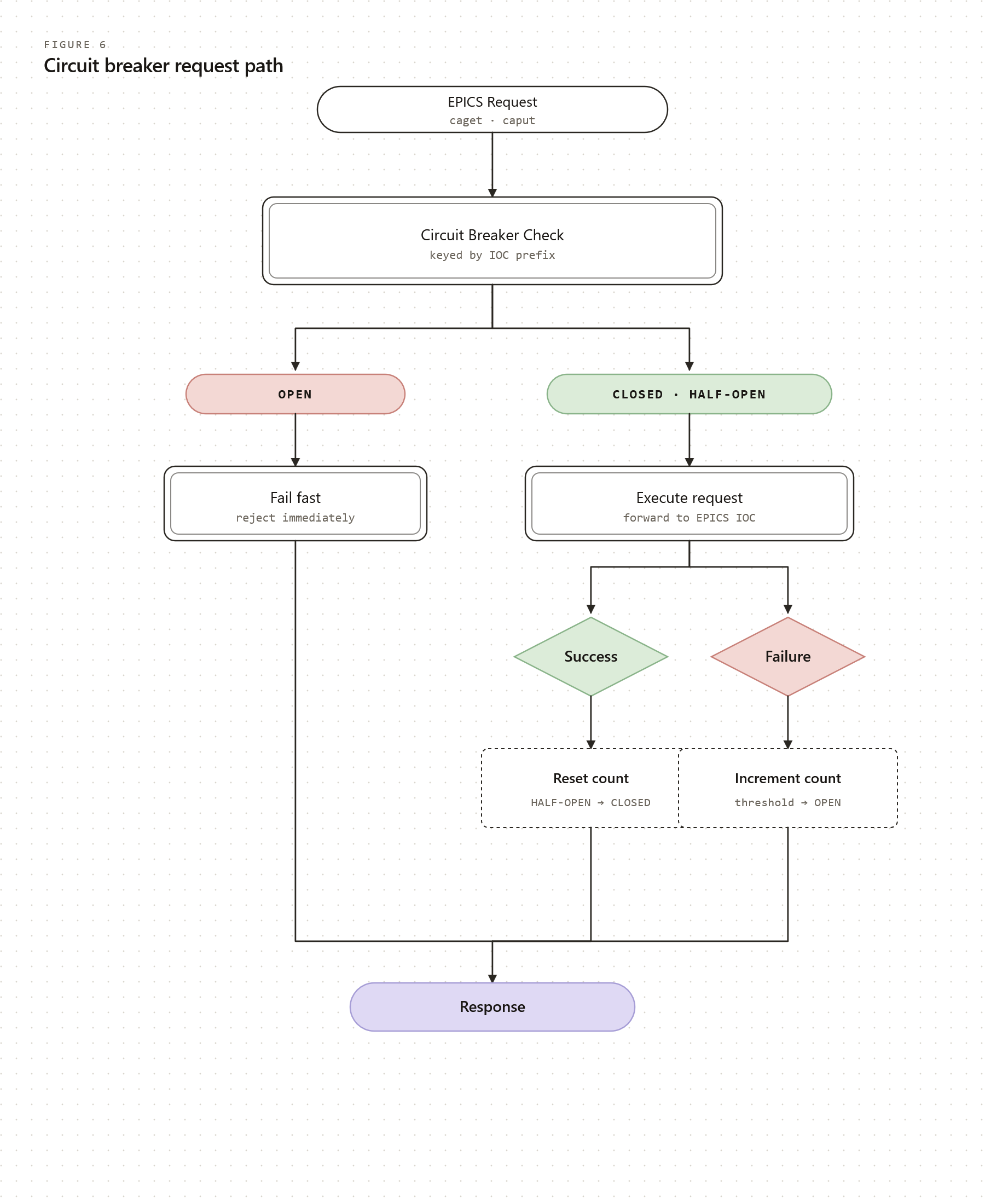
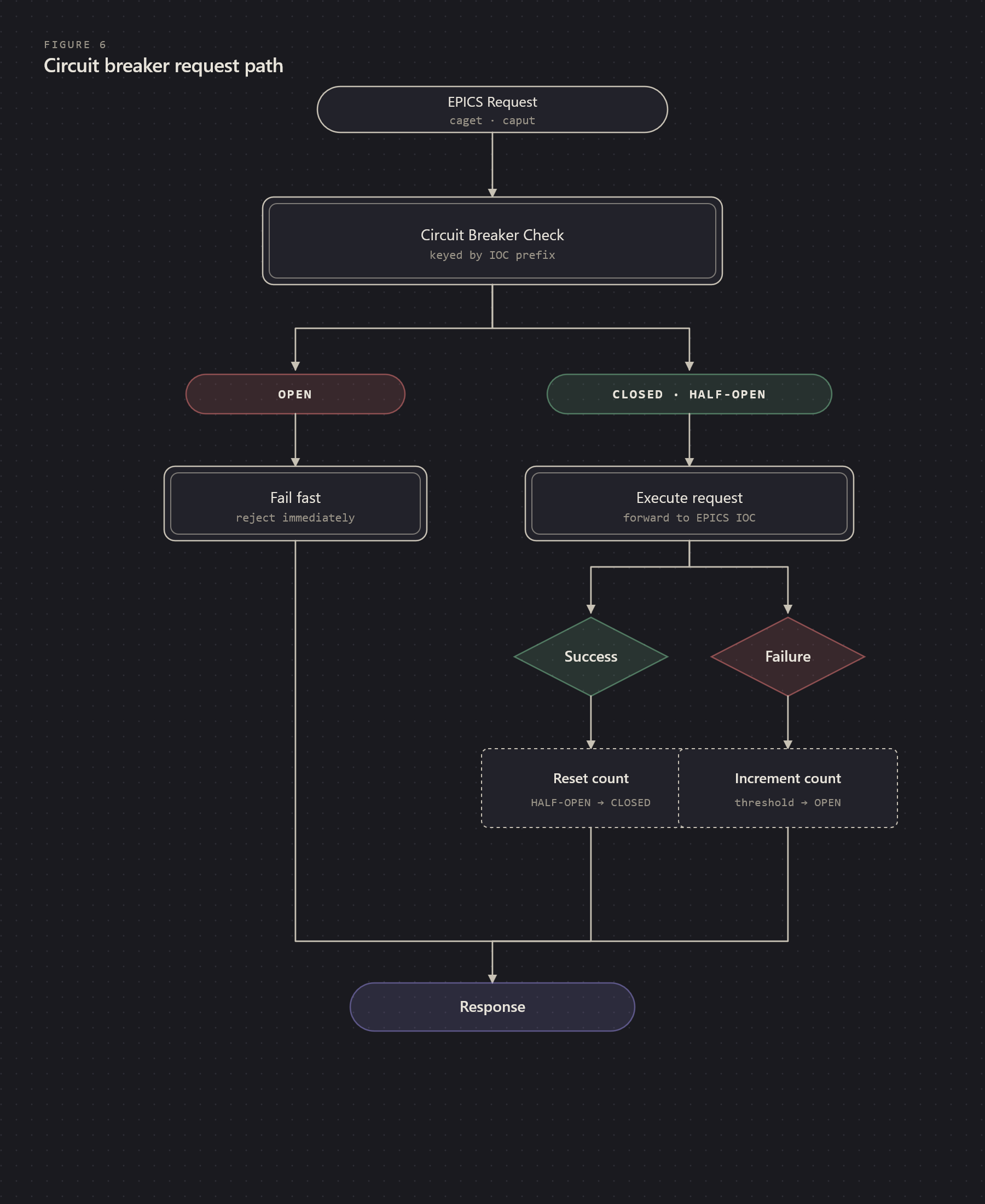
States:
- CLOSED: Normal operation, requests pass through
- OPEN: Too many failures, requests fail immediately
- HALF-OPEN: Testing if service recovered
Deployment Options
For Docker Compose and local-development setup, see Installation.
Health Monitoring
| Endpoint | Description |
|---|---|
/v1/health/heartbeat |
Lightweight liveness check (no auth) |
/v1/health/summary |
Consolidated health for dashboards (DB, Redis, monitor, watchdog) |
/v1/health/monitor/status |
PV monitor process health (via heartbeat) |
/v1/health/circuits |
Circuit breaker status by IOC prefix |
See REST Endpoints › Health for the full list.