ZeroMQ server for Rogue control, request/reply, and publish updates. More...
#include <ZmqServer.h>
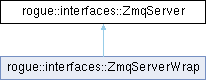
Public Member Functions | |
| ZmqServer (const std::string &addr, uint16_t port) | |
| Constructs a ZeroMQ server. | |
| virtual | ~ZmqServer () |
| Destroys server and stops worker threads/sockets. | |
| void | publish (boost::python::object data) |
| Publishes an update payload on the publish socket. | |
| virtual boost::python::object | doRequest (boost::python::object data) |
| Handles one binary request payload. | |
| virtual std::string | doString (const std::string &data) |
| Handles one string request payload. | |
| uint16_t | port () |
| Returns currently bound base port. | |
| void | stop () |
| Stops server threads and closes sockets. | |
| void | start () |
| Starts server, binds sockets, and launches worker threads. | |
Static Public Member Functions | |
| static std::shared_ptr< rogue::interfaces::ZmqServer > | create (const std::string &addr, uint16_t port) |
| Creates a ZeroMQ server. | |
| static void | setup_python () |
| Registers Python bindings for this class. | |
Detailed Description
ZeroMQ server for Rogue control, request/reply, and publish updates.
ZmqServer exposes three sockets:
- Publish socket on
basePortfor asynchronous update messages. - Binary request/reply socket on
basePort + 1. - String request/reply socket on
basePort + 2.
start() binds sockets and launches worker threads for binary and string request handling. If constructed with port == 0, the server scans for an available base port starting at 9099 in increments of 4.
Definition at line 47 of file ZmqServer.h.
Constructor & Destructor Documentation
◆ ZmqServer()
| rogue::interfaces::ZmqServer::ZmqServer | ( | const std::string & | addr, |
| uint16_t | port | ||
| ) |
Constructs a ZeroMQ server.
This constructor is a low-level C++ allocation path. Prefer create() when shared ownership or Python exposure is required.
- Parameters
-
addr Bind address/interface. port Base port. Use 0for auto-allocation.
Definition at line 58 of file ZmqServer.cpp.
◆ ~ZmqServer()
|
virtual |
Destroys server and stops worker threads/sockets.
Definition at line 67 of file ZmqServer.cpp.
Member Function Documentation
◆ create()
|
static |
Creates a ZeroMQ server.
Parameter semantics are identical to the constructor; see ZmqServer() for bind/setup behavior details. This static factory is the preferred construction path when the object is shared across Rogue graph connections or exposed to Python. It returns std::shared_ptr ownership compatible with Rogue pointer typedefs.
- Parameters
-
addr Bind address/interface. port Base port. Use 0for auto-allocation.
- Returns
- Shared pointer to the created server.
Company : SLAC National Accelerator Laboratory
Description:
Rogue ZMQ Control Interface
This file is part of the rogue software platform. It is subject to the license terms in the LICENSE.txt file found in the top-level directory of this distribution and at: https://confluence.slac.stanford.edu/display/ppareg/LICENSE.html. No part of the rogue software platform, including this file, may be copied, modified, propagated, or distributed except according to the terms
contained in the LICENSE.txt file.
Definition at line 37 of file ZmqServer.cpp.
◆ doRequest()
|
virtual |
Handles one binary request payload.
- Parameters
-
data Request payload as Python object.
- Returns
- Response payload as Python object.
Reimplemented in rogue::interfaces::ZmqServerWrap.
Definition at line 238 of file ZmqServer.cpp.
◆ doString()
|
virtual |
Handles one string request payload.
- Parameters
-
data Request payload string.
- Returns
- Response payload string.
Reimplemented in rogue::interfaces::ZmqServerWrap.
Definition at line 215 of file ZmqServer.cpp.
◆ port()
| uint16_t rogue::interfaces::ZmqServer::port | ( | ) |
Returns currently bound base port.
- Returns
- Base port number.
Definition at line 211 of file ZmqServer.cpp.
◆ publish()
| void rogue::interfaces::ZmqServer::publish | ( | boost::python::object | data | ) |
Publishes an update payload on the publish socket.
- Parameters
-
data Python object exposing a readable buffer.
Definition at line 221 of file ZmqServer.cpp.
◆ setup_python()
|
static |
Registers Python bindings for this class.
Setup class in python.
Definition at line 43 of file ZmqServer.cpp.
◆ start()
| void rogue::interfaces::ZmqServer::start | ( | ) |
Starts server, binds sockets, and launches worker threads.
Definition at line 71 of file ZmqServer.cpp.
◆ stop()
| void rogue::interfaces::ZmqServer::stop | ( | ) |
Stops server threads and closes sockets.
Definition at line 117 of file ZmqServer.cpp.
The documentation for this class was generated from the following files:
- /home/runner/work/rogue/rogue/include/rogue/interfaces/ZmqServer.h
- /home/runner/work/rogue/rogue/src/rogue/interfaces/ZmqServer.cpp